DK5OH
DK5OH
VHF Contest May 2025
- An exciting neck-and-neck race.
This year, unfortunately, some team members were unable to attend due to
family commitments. In addition, the DR9A Black Forest radio operators
decided to take part in this contest themselves this year, which is why
of course no DR9A delegation was able to come to the Wasserkuppe to
support us.
We therefore decided to take part this year only on 2m with a small
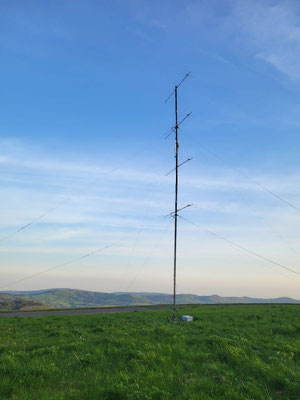
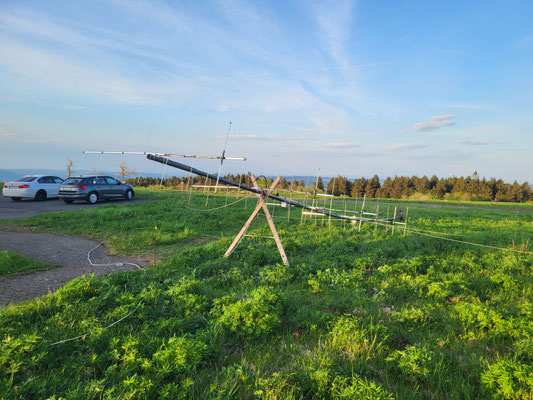
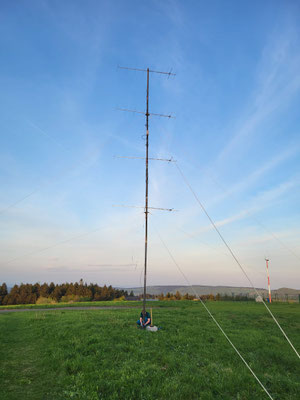
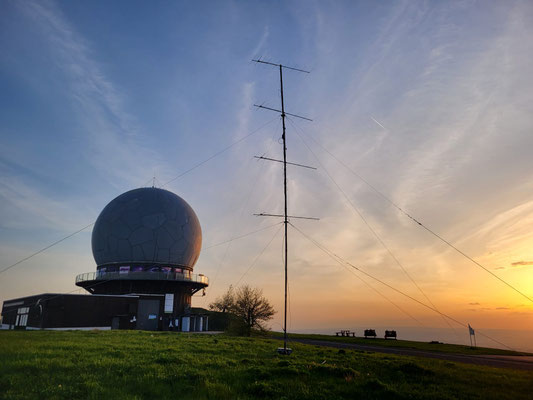
setup.For DA0FF, small setup means 4x 4*9el. Yagis.
A few weeks ago, Max (DK5MX) and Tim (DK5OH) checked and loaded the
equipment. It was discovered that all of the glow plugs in our contest
van are now defective. As a result, the engine starts very poorly or
not at all in cold temperatures. Unfortunately this was a problem that
we were unable to fix before the contest.
On Friday afternoon, one day before the contest, Max (DK5MX),
Ben (DA1DX) and Tim (DK5OH) met at our camp in Fulda. Fortunately the
contest van took off without any problems, so we were able to make our
way to the Wasserkuppe together.
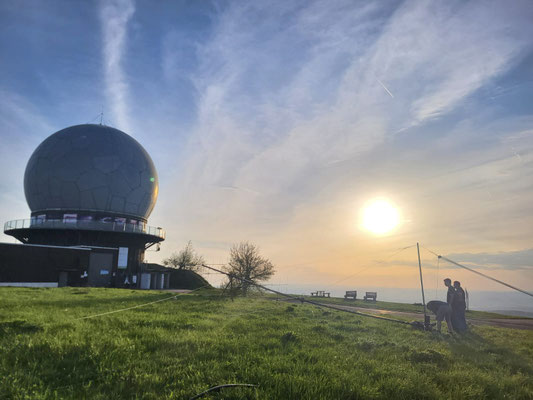
At around 13:30 UTC, we then started setting up the station. We have
now optimised the equipment so that we only need a total of 4 hours to
set up the 4 antenna masts. We therefore had enough time, were able to
carry out the assembly in a very relaxed manner and took sufficient
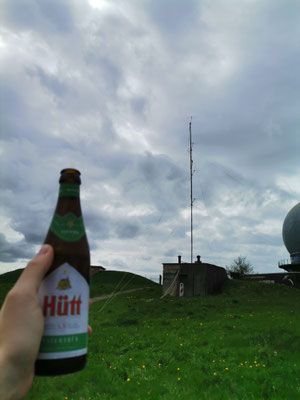
breaks with refreshing isotonic cold drinks which we call beer in
Germany.
Jan (DL2ZXA) arrived on the Wasserkuppe at around 15:30 UTC. By the
evening, 3 antenna systems were in place and the first beacons could
be heard. As expected, the technology ran smoothly and so we were able
to enjoy our classy Wasserkuppe barbecue without any stress.
The next morning at 8am UTC we started setting up the last antenna
system. Andy (DL4XX) and Louis (DK4EE) joined us and after a short
time the last mast with 4x9el. Yagi was ready to go.
We made the first test QSOs and optimised our microphone audio
(thanks for the numerous qualified reports).
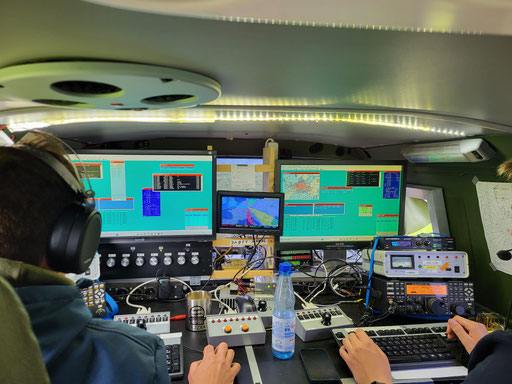
The contest got off to a sporty start at 14:00 UTC. Despite the
smaller set-up, Tim (DK5OH) and Louis (DK4EE) had a big pile-up to work
through. In the first hour, 138 QSOs were logged. In the second hour
still 112 QSOs and in the third hour 86 QSOs. We could already hear the
approaching thunderstorm on the band. We checked the rain/lightning
radar and realised that something ‘big’ was heading our way.
We saw the thunderstorm approaching and decided to unplug all the
antenna cables at around 16:15 UTC and sit in the vehicles with an
isotonic cold drink to wait out the storm. We had never experienced
such an extreme thunderstorm on the Wasserkuppe before. Lightning
flashed every second, hail and gusts of wind at 100 km/h. We looked
at our aerials with some concern, but the technology was able to
withstand this storm without any damage. After 45 minutes, the storm
was over and we were able to resume operations. In the following hour we
still had heavy pattering interference due to static rain, so that we
could only hear stations with very strong signals. Thank you at this
point for the patience of the calling stations.
Gradually the band calmed down and we were able to hear more distant
stations again as darkness fell.
At around 22h UTC, Louis (DK4EE) and Tim (DK5OH) handed over the station
to Ben (DA1DX) and Jan (DL2ZXA). The whole of Germany was now covered
by a large area of low pressure and dense clouds were moving over the
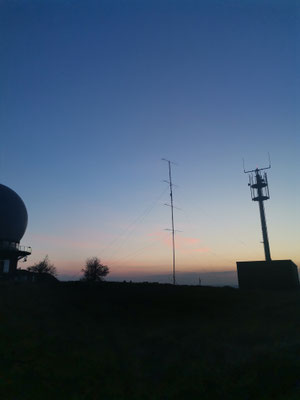
Wasserkuppe. The clouds were so thick that the lowest antenna on our
mast could no longer be recognised (visibility less than 6m). The radio
conditions were correspondingly poor. DX connections in CW hardly made
it into the log. It rained continuously and no station over 1000km could
be reached, which has never happened since 2014! At 0:45 UTC,
Ben (DA1DX) and Jan (DL2ZXA) decided to end the radio operation.
At 04:30 UTC, Louis (DK4EE) and Tim (DK5OH) returned to the station.
It was still raining, but little by little more QSOs were being logged.
In the live score we saw that it was a neck-and-neck race between
IQ5NN, OL7M, DR9A and DA0FF.
The weather slowly improved and the dense fog lifted around 7am UTC,
which brought a significant improvement in the radio conditions. Now
more stations from the Balkans were coming into the log, so that the
kilometre average increased noticeably. Stations from Sweden were also
heard as strongly as usual. Unfortunately only very few stations from
the UK could be reached. So it was all the more surprising that
Steve (GW1YBB/p) called us at 12h UTC. Steve was transmitting from an
800m high mountain in IO81KW with only 5W and a 9el. Yagi. Steve was
relatively easy to hear. The QSO made us very happy and was our ODX
with 925km!

Here is our preliminary result:
QSO: 1061 (1020 without dupes)
Points:       324495
Average: 318 km/qso
ODX: GW1YBB/P (IO81KW) 925 km


Top 10 QSO:
GW1YBB/P 926 km IO81KW
YT7W 922 km JN95RE
9A0V 912 km JN95PE
SM6VTZ 889 km JO58UJ
HA8V 884 km KN06HT
9A8D 868 km JN95LM
E73O 866 km JN95CA
G8NEY/P 866 km IO81UN
E76C 845 km JN84SU
TM87C 841 km JN05MT


Fortunately, the weather remained stable and we were able to dismantle
without rain. After 3 hours, everything was packed onto the trailers.
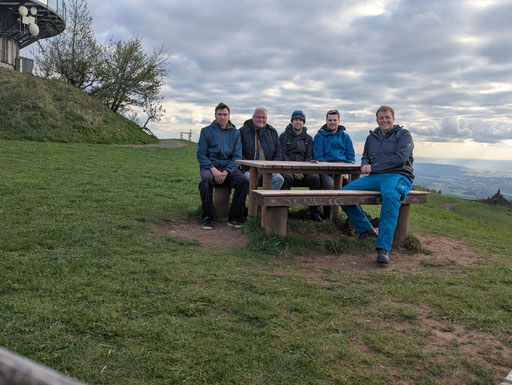
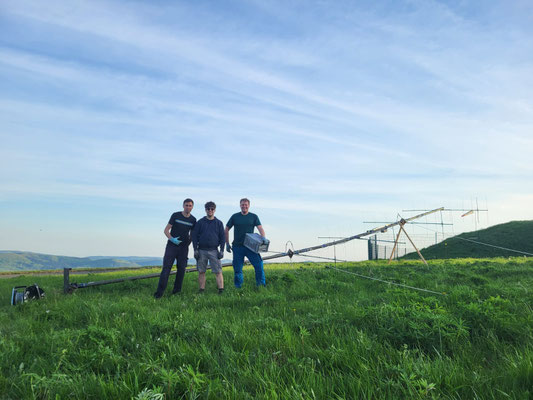
After the obligatory team photo, we left the Wasserkuppe at 17h UTC.
But there was something else....Right! The glow plugs of the contest
van. It was too cold and the engine wouldn't start. We joined forces to
push the Contest bus and after a few attempts the old bus was running
again. By the way, next year we can register our contest-van as a
historic vehicle.

Once again it was an exciting contest. Thanks for the many QSOs.
73 de DA0FF

(DA1DX, DK4EE, DK5MX, DK5OH, DL2ZXA, DL4XX)